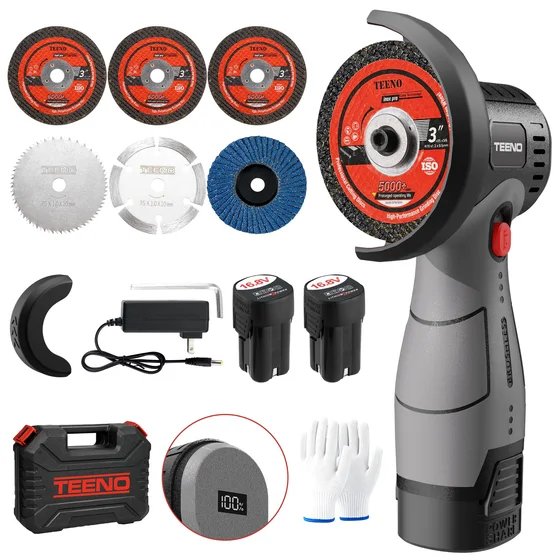
 16.8V / 21V19,500 RPM
3″ Mini Angle Grinder
3 in disc · 2 x 2.0 Ah batteries
7 colors
4.0 out of 5 · 1,165 ratings
from $26.99
Tool Up on AmazonGuide
Two sizes, two kinds of work. Here is how to pick between a 3-inch mini grinder and a 4-1/2 to 5-inch grinder, and how to match the disc to the job.

Two sizes
A mini grinder takes a 3 in disc. The 3″ Mini Angle Grinder spins it at 19,500 RPM and fits in one hand, so it reaches a bolt behind a bracket or a pipe under a sink. It cuts well and grinds a little.
A full-size grinder takes a 4-1/2 or 5 in disc. The 5″ Brushless Angle Grinder has three speeds up to 8,500 RPM and a side handle for two hands. It grinds welds and rust over a wide area and cuts thicker stock.
If most of your jobs are small cuts, start with the mini. If you clean up welds or strip paint off a trailer, the full-size grinder will save you hours. Plenty of people end up owning both.
16.8V / 21V19,500 RPM3 in disc · 2 x 2.0 Ah batteries
7 colors
4.0 out of 5 · 1,165 ratings
from $26.99
Tool Up on Amazon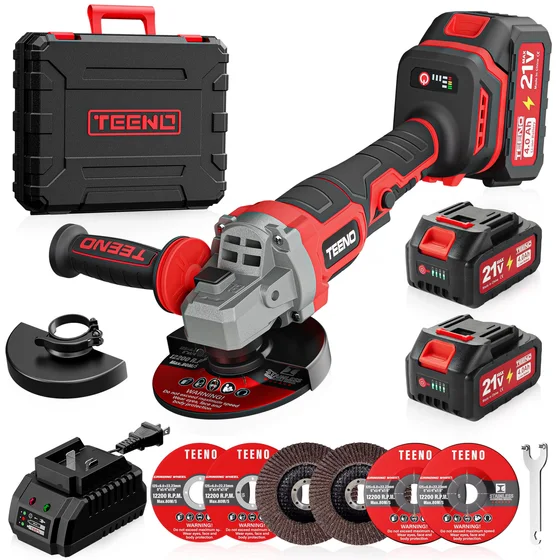 21V8,500 RPM
4-1/2 in and 5 in disc · 2 x 4.0 Ah batteries
4.7 out of 5 · 20 ratings
$76.49
Tool Up on AmazonDiscs
The grinder spins it. The disc does the work. Use each one the way it was made to be used.
Thin, for cutting with the edge: bolts, rod, angle iron, thin pipe. Do not grind with its flat face.
Thick and stiff, for taking down welds and rough edges on steel.
Overlapping sanding flaps, for rust, paint and blending a weld smooth.
For tile, stone and masonry edges. For long straight cuts, a saw with a base keeps the line.
Speed and guard
Every disc has a maximum speed printed on it. OSHA’s rule for workplaces puts it plainly: The spindle speed of the machine shall be checked before mounting of the wheel to be certain that it does not exceed the maximum operating speed marked on the wheel.
OSHA, 29 CFR 1910.243 For the 3″ Mini Angle Grinder, that means a disc rated for at least 19,500 RPM.
The same rule says Abrasive wheels shall be used only on machine provided with safety guards
OSHA, 29 CFR 1910.243, and for hand-held grinders like ours, the top half of the wheel shall be enclosed at all times.
OSHA, 29 CFR 1910.243 Keep the guard on, and turn it so it sits between you and the disc.
OSHA also asks for eye protection that provides side protection when there is a hazard from flying objects.
OSHA, 29 CFR 1910.133 Sparks and disc fragments fly sideways as often as straight ahead.
Before you start
No cracks or chips, and a speed rating at or above the grinder’s top speed.
Between you and the disc, covering the top half.
A clamp or a vise holds it still, so both hands stay on the tool.
Wait for the disc to stop before you set the grinder down. The 5″ Brushless Angle Grinder brakes on its own when you let go.
Side by side
| Compared | 3″ mini grinder | 5″ grinder |
|---|---|---|
| Disc size | 3 in | 4-1/2 in and 5 in |
| Top speed | 19,500 RPM | 8,500 RPM, three speeds |
| Batteries in the kit | Two 2.0 Ah | Two 4.0 Ah |
| How you hold it | One hand | Two hands with the side handle |
| Better choice when | Cuts are small or in tight spots | You grind welds, rust and paint |
Questions
No. The 3″ Mini Angle Grinder takes 3 in discs only. For 4-1/2 and 5 in discs, use the 5″ Brushless Angle Grinder.
The 5″ Brushless Angle Grinder: a 5 in flap disc covers more surface, and the low 3,000 RPM speed keeps it under control on thin sheet.